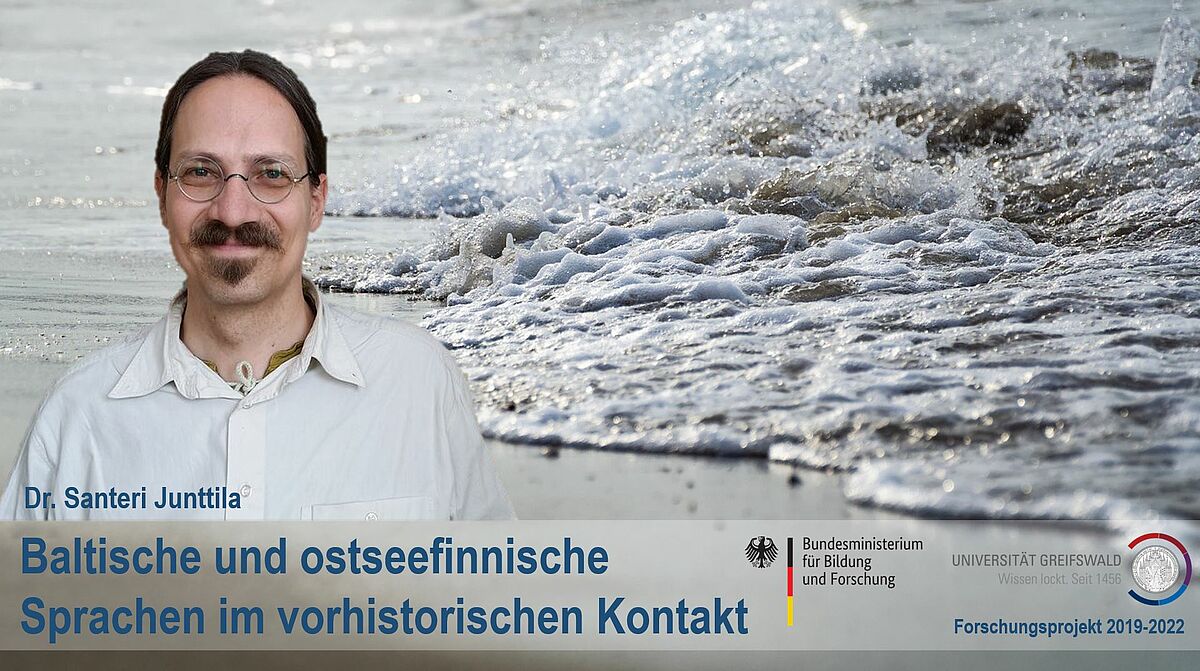
Project manager: Santeri Junttila, PhD
Host: Chair of Finnish Studies
Project duration: 9/2019 to 8/2022
Funding organisation: BMBF
Funding programme: Kleine Fächer - Große Potenziale
Current news
Publications of in 2021:
Junttila S*, Holopainen S*, Kallio P*: Lainasanatutkimus Virittäjässä ja muualla (original article), Virittäjä. Kotikielen seuran aikakauslehti. 2021; 125(4):499-519.
Junttila S*: Osmo Nikkilän Angervojen alkuperistä (original article), Virittäjä. Kotikielen seuran aikakauslehti. 2021; 125:258-263.
Junttila S*: Mitä yhteistä on liettuan ja suomen kielillä? (overview article). Särö. 2021; 43-44:105-110.
Junttila S, Kallio P: Eesti keel läks ajalukku. (Review of: Külli Prillop, Karl Pajusalu, Eva Saar, Sven-Erik Soosaar & Tiit-Rein Viitso: Eesti keele ajalugu. Tartu 2021). In: Keel ja Kirjandus. 2021; 61:1110-1116.
Junttila S* : Wotistische Überraschung versteckt sich über die Jahrtausendwende (Reviewed works: Barbera, Manuel: A short etymological glossary of the Votic language. Città di Castello 2013 (1994); Introduzione storico-descrittiva alla lingua vota (fonologia e morfologia). Città di Castello 2012 (1995)). Finnisch-Ugrische Forschungen. (open access) 2021; 66:235-238. https://journal. fi/fuf/article/view/111180/66476 [de]
Junttila S*: Mystinen taulukko. In: Saarikivi J (ed. and author), Saarikivi T (ed.). Turhan tiedon kirja. Tutkimuksista pois jätettyjä sivuja. Helsinki: Suomalaisen Kirjallisuuden Seura; 2021. p. 149.
Junttila S*: Suomen vanhimman sanaston etymologisen verkkosanakirjan puolituntinen esittelyvideo on suunnattu kaikille verkkosanakirjan käyttäjille, myös sen tekemisestä kiinnostuneille alan tutkijoille. Video. Helsinki: University of Helsinki; 2021. https://blogs. helsinki.fi/etymologinenverkkosanakirja/esittelyvideo/ [fi]
17 November 2020 On the eve of Latvian Independence Day, an article in Latvian by Santeri Junttila on the linguistic relations between the Balts and Baltic Finns going back 3000 years [lv].
13-18 October 2020 Santeri Junttila is invited to spend a residency at the Oder Residency belonging to the cultural magazine Särö to complete an article on Lithuanian-Finnish language contacts.
14 September 2020 The student blog Baltic Cultures publishes an interview with Santeri Junttila.
22 June 2020 Santeri Junttila presents the web-based etymological dictionary project he is leading in the Karelian-language programme of Russian television, which is closely linked both technically and in terms of content to the Greifswald BMBF project "Baltic and Baltic Finnic Languages in Prehistoric Contact".
12 May 2020 Update of the etymolological online dictionary [fi] of the oldest Finnish vocabulary. The project of the University of Helsinki, which is closely linked to the research project in Greifswald, presents the first 50 generally understandable etymologies [fi] for a broad audience.
17 March 2020 Pre-edited PDF version A-H (lexeme selection)
22 February 2020 The etymologies of the first lexemes are online for discussion: Link
22 February 2020 The first pre-edited PDF version of the lemmas beginning with h is online.
Baltic and Finnic Languages in Pre-Historic Contact
The aim of the project is to prepare a foundational, in part encyclopaedic monograph that provides an overview on lexical traces of prehistoric Finnic – Baltic language contact. This work has long been a desideratum in teaching and research in Finnish/ Finno-Ugric Studies as well as in Baltistics and the archaeology of the Baltic Sea Region. Being a foundational work of areal research on historical language contact, it represents a link connecting this field with areal typological basic research as well as with lexicological-semantic research of neighbouring philological disciplines. Based on the research of old Germanic – Finnic loan relationships, which led, among others, to the relevant language contacts being redated, Finno-Ugric research successfully established a highly developed toolkit for the identification of loan words. Thanks to the Baltic-Finnic research project, the toolkit’s potential of transfer to general linguistics will be further improved and it will become considerably more widely known internationally. The character of the loan vocabulary allows for important conclusions on the development in the eastern Baltic Sea Region in terms of cultural history. For a lack of historical sources, linguistics plays an even more important role in the examination of prehistoric processes in that region than in cultural areas with early records. In order to include the interdisciplinary expertise of international experts, the lexical material that is worked on successively will be available for comments in a separate phase of preparation via a specially designed interactive online platform. Moreover, the entries in the part of the monograph that is an etymological dictionary are compiled according to an innovative lexicographical structuring principle. This structure provides visually supported information on, among others, the spread and the meanings of the individual lemmata which are proposed for a Baltic loan etymology in the 22 main Finnic dialects.